The first time I kneel on a summer hike and ask a group to look at the ground instead of the glacier, there is always a pause. Then someone finds a poppy the size of a thumbnail in frost-shattered gravel, and the trip changes shape. Svalbard’s plants are the most stubborn thing on the archipelago.
What Arctic tundra actually is
Tundra is what you get when the ground never fully thaws. Permafrost underlies almost the entire archipelago, often hundreds of metres deep. Only the top active layer, a few tens of centimetres, thaws each summer, and that thin frost-churned skin is the whole rooting zone available here.
Permafrost also blocks drainage, so early-summer meltwater sits on the surface and the ground turns to quagmire, then dries hard. Most of Svalbard is also a high-Arctic desert: precipitation around Longyearbyen runs about 200 mm a year, less than many real deserts. That is the brief every plant works to.
Why there are no trees
There are no trees anywhere in Svalbard, and the reasons stack rather than compete. A tree needs a deep root run, and permafrost forbids it. It needs a season long enough to harden woody tissue, and six to eight weeks does not deliver. Anything standing above the snowpack meets ice-laden winter wind that sandblasts whatever it reaches.
So the vegetation solved the problem by lying down.
- The polar willow (Salix polaris) is technically Svalbard’s tallest tree: a genuine woody willow a few centimetres high, creeping flat, with leaves the size of a fingernail and its trunk hidden horizontally under the moss.
- The dwarf birch that carpets mainland Scandinavian tundra does not occur here. Svalbard is too far north and too cold for it.
- The rule everywhere is the same: stay below the snow line in winter. Snow is insulation, and anything above it dies.
How much actually grows here
Around 170 species of vascular plants are recorded in Svalbard: flowering plants, grasses, sedges, rushes and those tiny willows. A single mainland Norwegian county beats that, and vascular plants are only part of the story.
Mosses and lichens dominate the ground cover, and they are the real old-timers:
- Lichen grows at fractions of a millimetre per year. A crust the size of your palm can be centuries old, and on the most stable surfaces these communities are reckoned in hundreds to thousands of years.
- Moss carpets bind the loose, frost-heaved ground and hold what moisture there is. They are also the winter larder reindeer dig for.
- A single bootprint in wet moss can stay visible for decades. Nobody invented that line to make visitors behave. Up here, damage does not grow back within a working life.
Which is why, on our summer hikes, we walk on rock, gravel, snow and existing trails wherever the terrain allows, and why I steer a group the long way round a green hollow rather than cut across it.
The short, violent summer
The growing season is six to eight weeks. That is the whole budget.
- Snowmelt over most low ground runs through June.
- Midnight sun runs roughly 20 April to 22 August, so once growth starts there is no night to pause it. Plants photosynthesise around the clock.
- Flowering peaks from late June into July, in a tight, almost simultaneous burst of colour across whole slopes.
- By mid-August the tundra is turning. By September it is rust, crimson and ochre, and the seed is set.
Many species hedge by being perennials that flower only once they have banked enough energy, skipping years if need be, and some carry last year’s buds fully formed under the snow, ready to open days after melt-out.
Species worth knowing by name
- Purple saxifrage is the first bloom of the year, sometimes pushing magenta up through the edge of a snowdrift in late May. Purple against grey gravel means spring has technically started.
- Svalbard poppy, pale yellow or cream on a hairy stem, grows straight out of bare scree. The signature flower of the archipelago.
- Mountain avens carry white eight-petalled flowers that track the sun, warming their own centre by a few degrees; insects use them as heated shelters.
- Moss campion forms dense green cushions studded with pink flowers, sometimes a foot across. The cushion is a windbreak and a heat trap, and an old one is decades in the making.
- Arctic bell-heather nods white bells on wiry evergreen stems, prized by researchers because its growth increments count like tree rings.
- Cotton grass waves white seed heads over wet ground in late summer, and it is the easiest tundra plant to identify at a hundred metres.
Green lawns under the bird cliffs
Walk below a seabird colony and the tundra changes completely: thick, almost lawn-like green, with lush moss, saxifrages and scurvygrass. The reason is guano. Millions of little auks and guillemots feed at sea and drop nitrogen and phosphorus on the slopes below, importing marine nutrients onto starved ground. These bird-cliff meadows are the most productive vegetation in Svalbard, and they pull in reindeer, geese and the foxes hunting them. Below Platåberget and on the approach to Fuglefjella, that band of green against grey scree is unmistakable from a kilometre away.
What the animals do to the plants
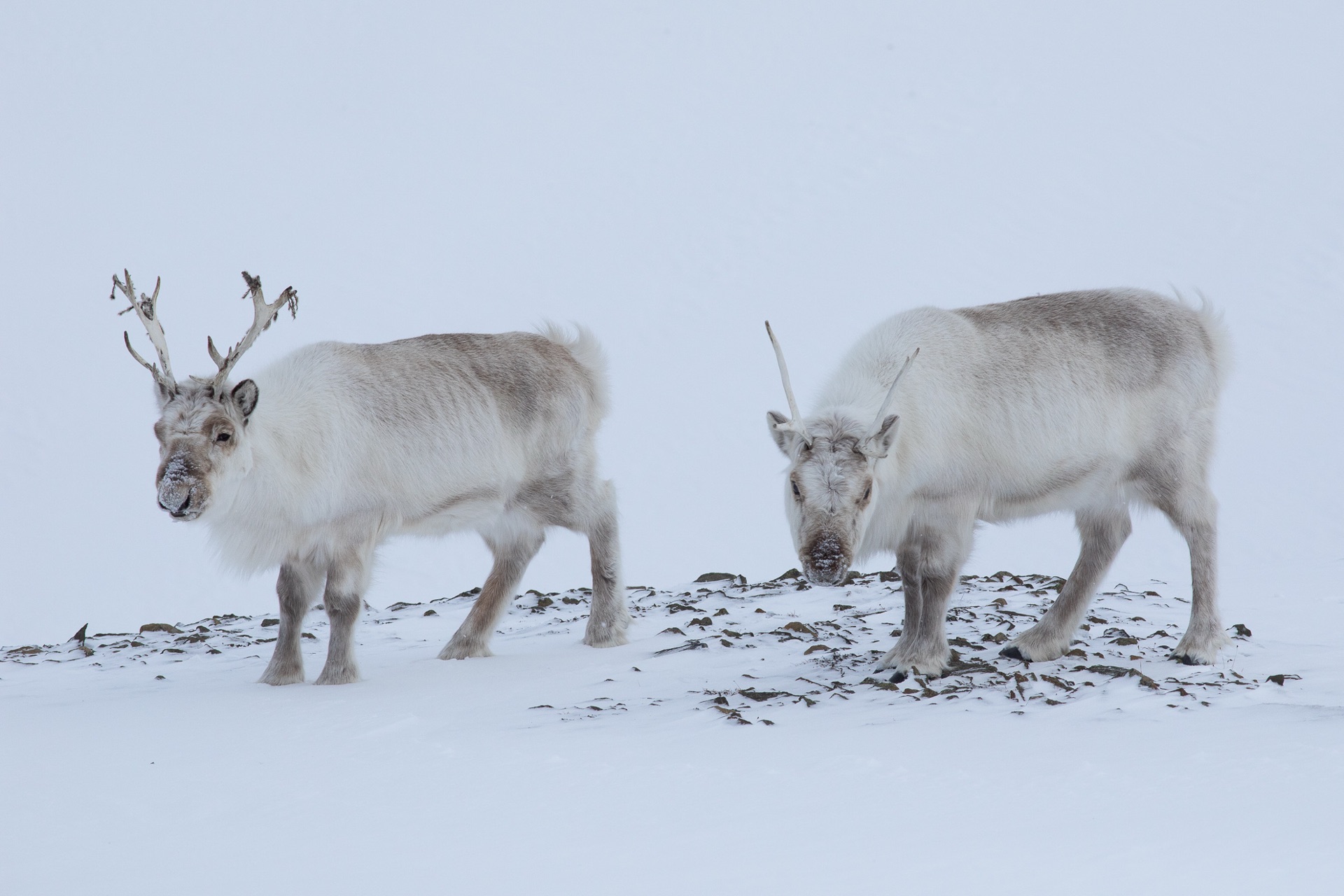
- Svalbard reindeer graze year-round, cropping the lawns in summer and digging through snow for moss and lichen in winter. Heavy grazing holds a patch short for years.
- Barnacle and pink-footed geese arrive in thousands each spring. The pink-footed grub for below-ground plant parts, leaving torn patches that take years to close.
- Reindeer have no natural predators here, so the herd is regulated by winter icing rather than by hunting, and grazing intensity swings with the weather.
Do not bring anything with you
A warming Arctic makes invasive species a real threat, and seeds travel on people.
- Clean your boots before you fly. The lugs and the seam around the sole especially, plus poles, tripod feet and rucksack bases. Do it again between boat landings, so you do not carry seed from a bird-cliff meadow into a pristine bay.
- Pick nothing. Several Svalbard plants are protected, and where a cushion may be older than your grandparents, a picked flower is not a souvenir.
The tundra through the year
From November to March the tundra is invisible, everything under snow or scoured bare, simply waiting. April and May bring the first purple saxifrage on south-facing gravel and meltwater starting to move, with the ground still mostly white. June and July are sodden at first, then the flowering burst arrives: poppies, avens, moss campion and saxifrage all at once under the midnight sun. August and September are the colour turn. Hillsides go red and gold, cotton grass nods over the wet flats, and the light returns at a low angle. Those are my favourite hiking weeks of the year.
On our summer walks in Bjørndalen and Endalen, and at the boat landings on the Catch of the Day cruise with MyArctic, this is the layer I most enjoy showing people, because once you have looked closely at a willow the height of a coin, you never see the Arctic as empty again.
FAQ
Are there really no trees on Svalbard?
None. Permafrost, a six-to-eight-week season and ice-laden wind rule them out. The polar willow, a few centimetres tall, is as close as it gets. Pick nothing, either, because several species are protected.
When do the flowers bloom?
Purple saxifrage can open in late May, but the main peak is late June through July. By mid-August the tundra is already changing colour.
Why can’t I walk on the moss?
Because the mark stays. Mosses and lichens grow so slowly that one footprint can remain visible for decades. Walk on rock, gravel, snow or established paths.

If you would like to spend a summer day actually on the tundra, walking the valleys around Longyearbyen, landing on shorelines only reachable by boat, learning to read the ground rather than the horizon, our guided hikes and cruises with MyArctic are run by SGO-certified guides who live here through every season. Small groups, trained for polar-bear safety, very few footprints left behind. See also Arctic Animals (Fauna) and Safety and Polar Bears.